What Is Color Measurement? — Understanding and Measuring Color Accurately
PaPaLaB Color
Measurement

Color is all around us and plays an important role in products, design, and quality control. However, color perception varies from person to person and is easily affected by lighting and the surrounding environment. Objective color measurement is therefore essential for accurate and consistent color management.
This page explains what color is, the difference between an individual color and overall coloration, and the principles of color measurement and inspection.
Contents
What Is Color?
Color is perceived through the interaction of three elements: the light source, the object, and the observer. When light strikes an object, some wavelengths are absorbed while others are reflected. The reflected light reaches the observer’s eyes, and the brain interprets it as color. Together, these three elements determine how color is perceived.
Light source:
Without light, color cannot be perceived. Color appearance changes depending on the type of light source, such as daylight, fluorescent lighting, or LED lighting.
Object:
The color perceived from an object depends in part on the wavelengths of light that its surface selectively reflects and absorbs. A red apple, for example, appears red because it reflects more light in the red region of the visible spectrum than in many other regions.
Observer:
The way the human eye and brain perceive color also affects color appearance. The same color may appear different depending on age, individual visual characteristics, and differences in color vision.
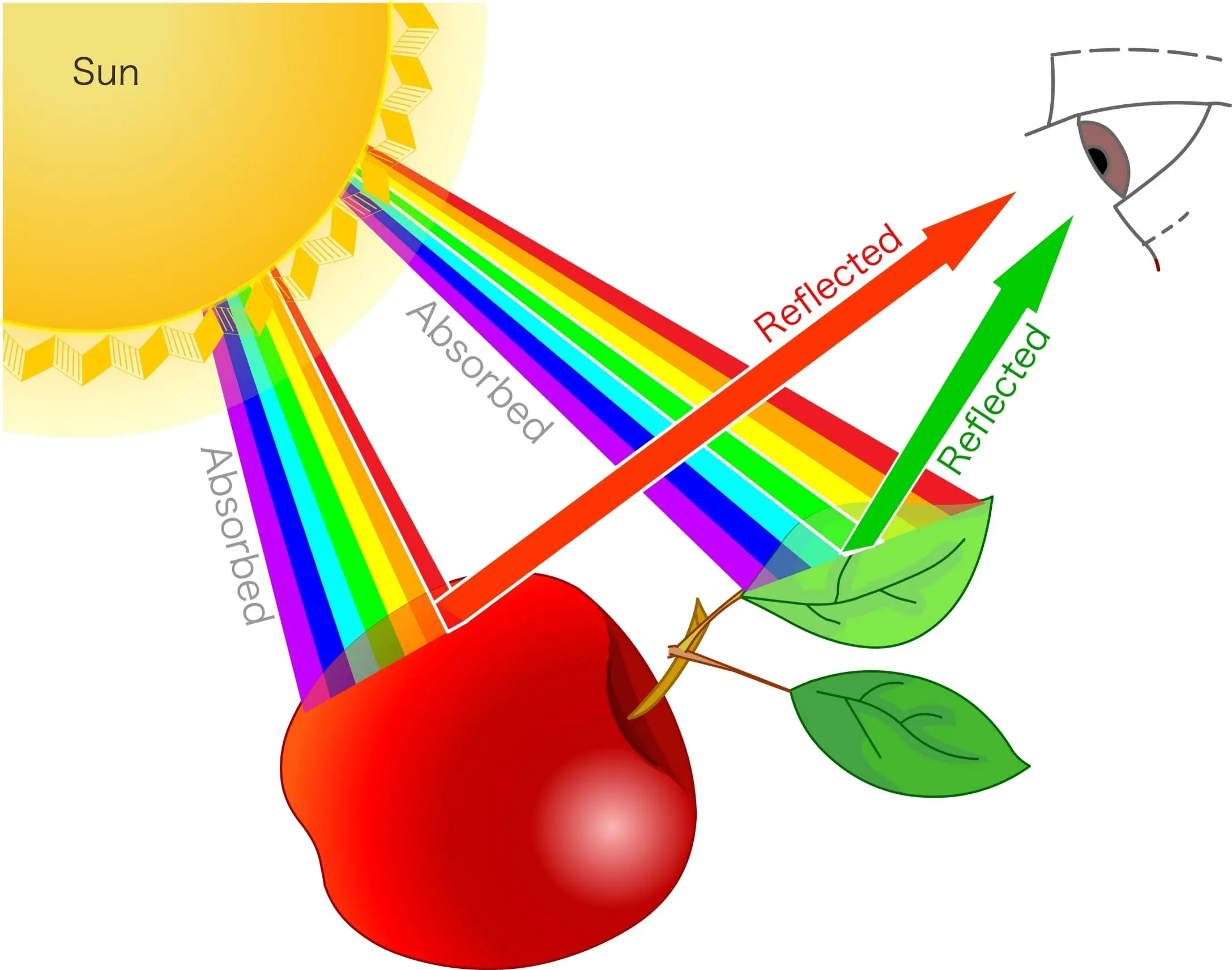
White Light from the Sun and Reflected Light
Color appearance changes depending on the light source, object, and observer. For example, the same white shirt may appear white in daylight but slightly yellow under an indoor lamp. This is because different light sources have different color temperatures and spectral power distributions.
Similarly, the same shade of red may appear different on paper and plastic because the materials reflect light differently, affecting their perceived texture and brightness. Color perception also varies according to the observer’s visual characteristics. Individual differences in color vision may make certain colors more difficult to distinguish.
Because color appearance is influenced by many factors, it is important to quantify color through measurement rather than relying solely on visual evaluation. Color measurement enables consistent evaluation by standardizing the light source and measurement conditions and managing color as objective data.
Color and Overall Coloration
The overall impression of color is influenced not only by the individual colors themselves, but also by their surroundings, textures, and the way they reflect light.
Even within the general category of “blue,” for example, the blue of the sky and the blue of the sea create different impressions. Subtle differences arise from their surroundings, textures, and the way they reflect light. This is because color appearance involves more than a simple collection of colors; it is also influenced by visual, psychological, and cultural factors.
PaPaLaB focuses on how color varies across an entire surface because real-world objects are rarely completely uniform in color. In product finishes and design, subtle color differences, variations, and combinations can significantly affect perceived quality. We therefore believe that accurately measuring and inspecting color across an entire surface is essential.

The Blue of the Sky and Sea
Color Measurement and Inspection
How color is perceived is influenced by light, materials, and human vision. Effective color management therefore requires objective color measurement rather than reliance on visual evaluation alone. Appropriate inspection criteria and procedures are also needed to ensure that measurement results are used effectively in quality control.
Proper color measurement and inspection help ensure color consistency and reproducibility, making it possible to maintain stable product quality.
Methods for Measuring Color
Various measurement methods are used to evaluate color objectively.
Spectrophotometric Measurement:
A method that measures how an object reflects or transmits light at different wavelengths across the visible spectrum. It is suitable for detailed color analysis at a specific point.
Color Difference (ΔE):
A numerical value that expresses the difference between a measured color and a reference color. It is used to monitor variations in product color and maintain consistent quality.
2D Color Measurement:
A method that measures the spatial distribution of color across a surface and analyzes characteristics such as color unevenness and gradients. It captures color information over an area rather than at a single point.
Conducting appropriate inspections based on measured color data makes it possible to maintain consistent product quality. In product inspection, for example, the color uniformity of painted or printed surfaces can be evaluated to reduce variation and ensure stable quality.
In the food and beverage industry, color is managed as an important quality indicator. Color is often inspected as an important indicator of freshness and product quality. Preventing color differences that may make a product appear inconsistent or undesirable is also important.
In industries such as fashion, textiles, cosmetics, and design, color must be carefully managed to ensure that intended colors are reproduced accurately.
By combining appropriate color measurement with inspection, color can be evaluated more accurately, enabling more reliable quality control based on objective color data.
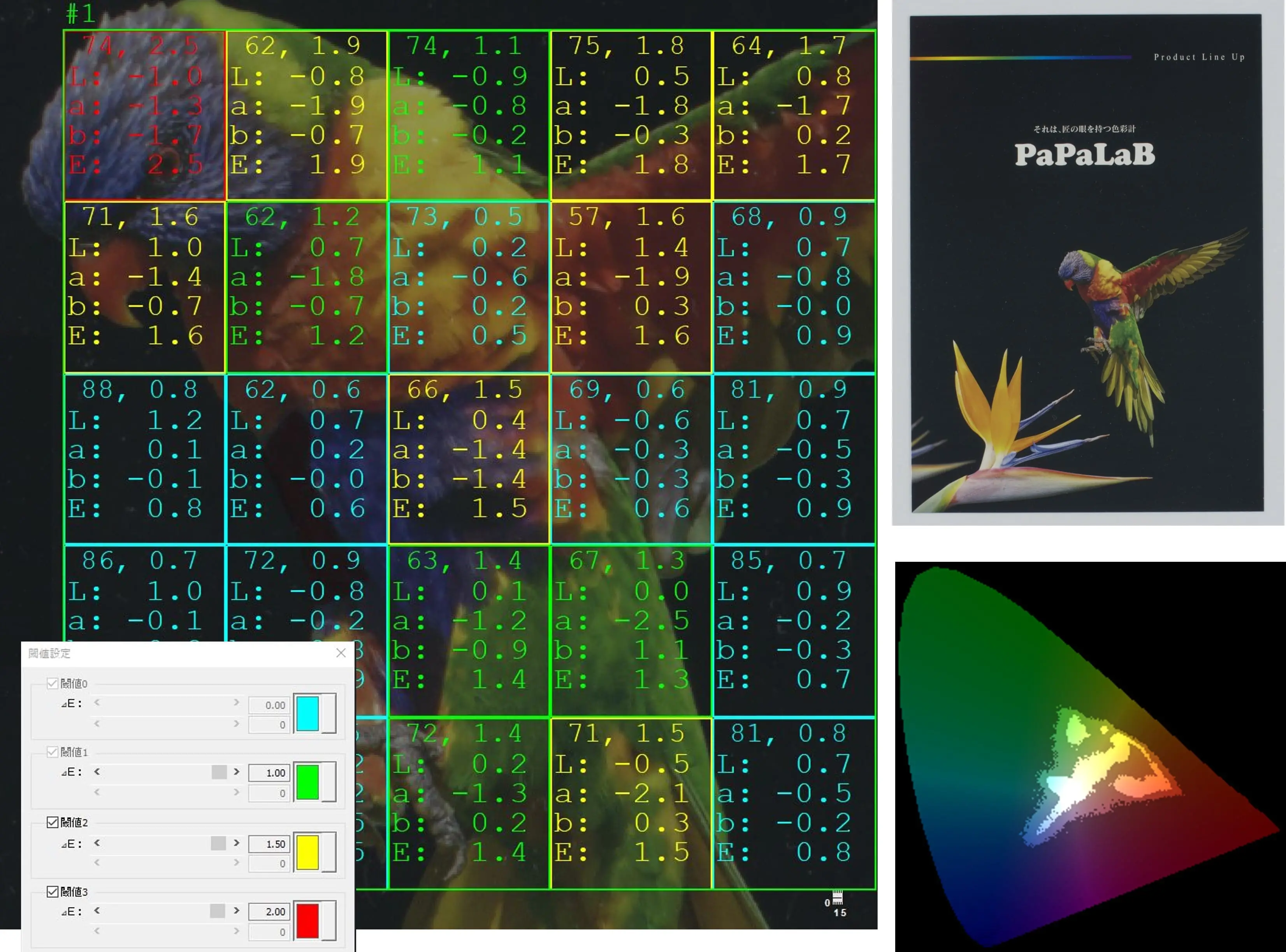
2D Color Measurement Image:(Left) Inspection Example (Upper Right) Entire Inspection Sample (Lower Right) Color Distribution
Color and Its Impact on Business — How Visual Appearance Can Influence Perception, Value, and TrustContact
Please feel free to contact us with any inquiries regarding our products, pricing, or quotations.
We also accommodate requests such as “I would like to see how measurement works in practice.”
Trial measurements are available, allowing you to experience actual measurement results firsthand.