What Is Color Difference (ΔE)? — Quantifying Differences Between Colors
PaPaLaB Color
Measurement
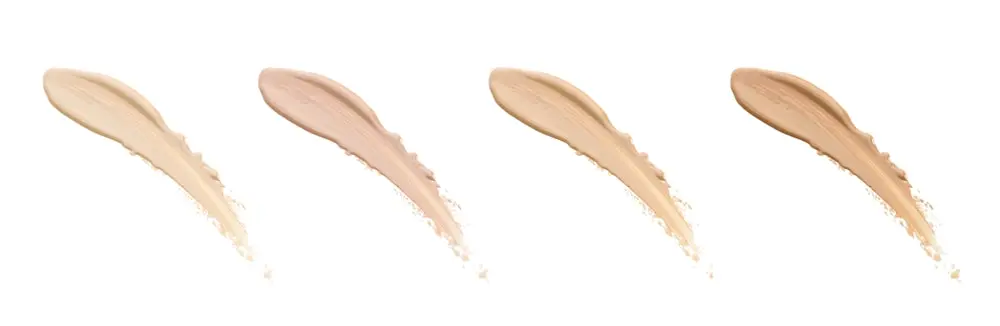
When a product color looks “slightly different,” relying solely on human perception can lead to inconsistent judgments.
In color quality control, differences between colors need to be evaluated objectively rather than based only on visual impressions. This is where color difference metrics such as ΔE are used.
This page explains the fundamentals of ΔE, the differences between major calculation methods, and how to choose the appropriate method for different applications.
Contents
What Is Color Difference (ΔE)? — Expressing Color Differences as Distance
Color difference, commonly expressed as ΔE, is a numerical measure of the difference between two colors.
In the CIELAB color space, a color is represented using three coordinates: L* (for lightness), a* (for the red–green axis), and b* (for the yellow–blue axis).
In the basic CIE76 method, the distance between two color coordinates in this three-dimensional space is used to quantify the difference between the colors.
Simply put, ΔE becomes larger as the difference between the two colors increases.
The most basic calculation method is CIE76 (ΔE*ab):
ΔE*ab = √[(L₂ − L₁)² + (a₂ − a₁)² + (b₂ − b₁)²]
This formula is simple to calculate and is supported by many color measurement instruments and software applications.
However, the numerical result does not always correspond perfectly to how differences are perceived by the human eye. For applications requiring more precise color control, more advanced color difference formulas are often used.
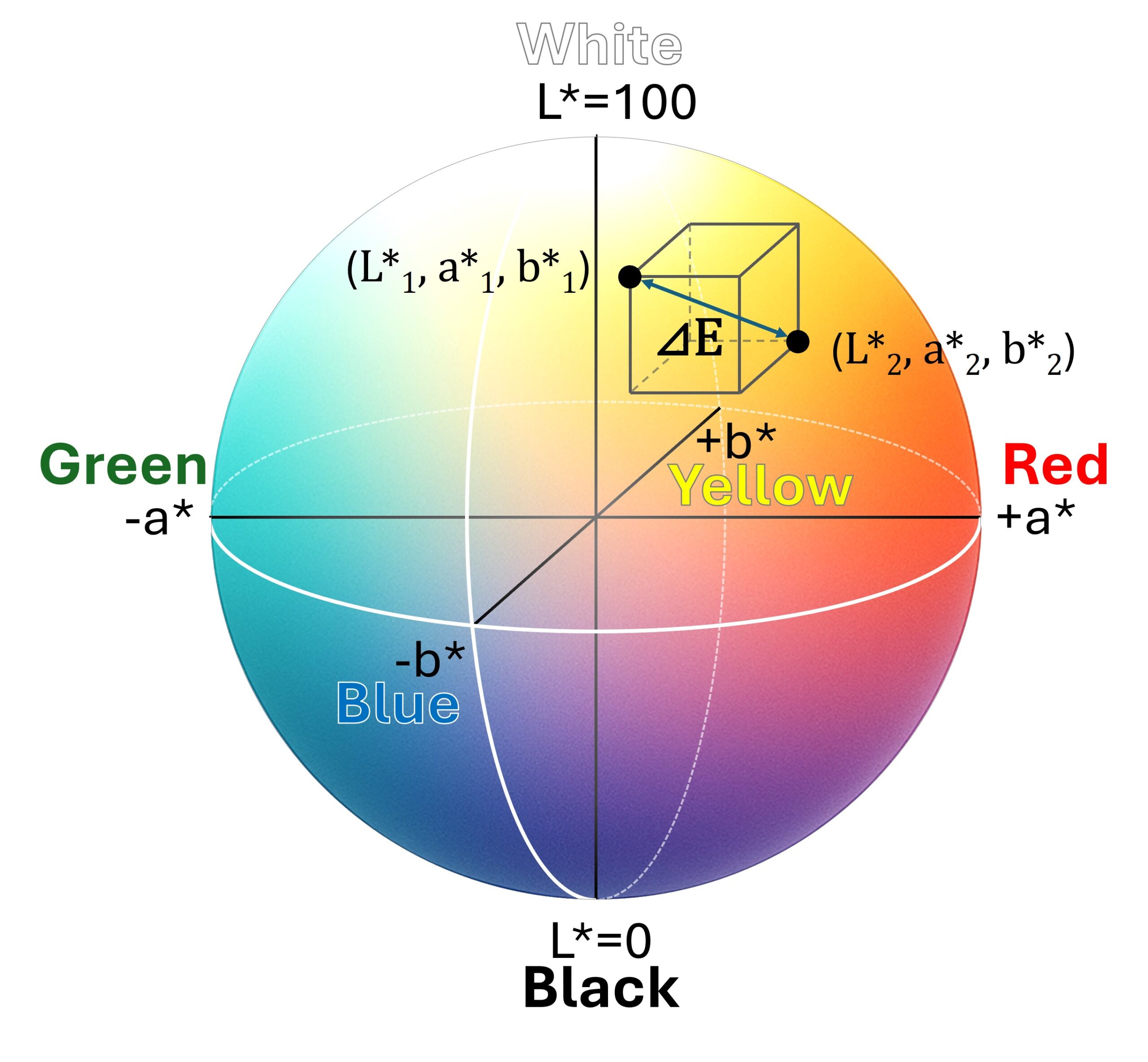
Calculating Color Difference (ΔE): The Distance Between Two Colors in L*a*b* Space
Understanding ΔE Values — How Much Color Difference Is Visible?
The following ranges provide only a general indication of how noticeable a color difference may be. The relationship between ΔE and visual perception varies depending on the color difference formula, material, surface characteristics, and viewing conditions.
– ΔE 0.0–0.5: An extremely small difference that is almost impossible for the human eye to distinguish.
– ΔE 0.5–1.0: A very subtle difference that may be noticeable in a direct side-by-side comparison.
– ΔE 1.0–2.0: A difference that may become noticeable when the colors are compared closely.
– ΔE 2.0–3.0: A clearly noticeable difference when the colors are viewed side by side.
– ΔE 3.0 or greater: A color difference that is generally noticeable and may be considered significant depending on the application.
Actual tolerance limits vary depending on the industry, product, material, viewing conditions, and customer requirements.
For example, some applications may require a tolerance of ΔE ≤ 1.0, while others may permit larger differences. Appropriate tolerance limits should be established according to the applicable industry standard, customer specification, material, measurement conditions, and color difference formula.
Advanced Color Difference Formulas — CIE94 and CIEDE2000
The human eye does not perceive color differences uniformly. Sensitivity to color differences varies depending on factors such as hue, lightness, and chroma.
To compensate for these differences in visual perception, more advanced formulas such as CIE94 and CIEDE2000 (ΔE00) were developed.
CIE94 (ΔE94)
CIE94 introduces weighting factors that account for differences in human sensitivity to changes in lightness (L*), chroma (C*), and hue (H*).
The equation can be expressed as:
ΔE94 = √[(ΔL / kL·SL)² + (ΔC / kC·SC)² + (ΔH / kH·SH)²]
CIE94 provides improved agreement with visual perception compared with CIE76 in many applications and has been used in industries such as printing and textiles.
CIEDE2000 (ΔE00)
CIEDE2000 was developed to improve the correlation between calculated color differences and human visual perception.
Compared with earlier formulas, it includes additional corrections such as:
– Hue rotation correction
– Nonlinear chroma correction
– Adjustments for interactions between lightness, chroma, and hue
Although the calculation is considerably more complex, CIEDE2000 is widely used because it provides improved agreement between calculated color differences and human visual perception.
It is used in applications where close agreement between instrumental measurements and visual evaluation is required.
Choosing a Color Difference Formula — Selecting the Right ΔE for the Application
Each color difference formula has different characteristics and should be selected according to the application and evaluation requirements.
– ΔE*ab (CIE76): Simple to calculate and suitable for basic color difference evaluation and management.
– ΔE94 (CIE94): Provides more refined evaluation by compensating for differences in visual sensitivity depending on the direction of the color difference.
– ΔE00 (CIEDE2000): Provides improved correlation with human visual perception compared with earlier formulas and is widely used in modern color evaluation.
CIEDE2000 is widely used when closer agreement with visual evaluation is required.
The most appropriate formula, however, should be selected according to the applicable industry standard, customer specification, material, and required tolerance.
Practical Applications of Color Difference — Using ΔE for Inspection and Decision-Making
ΔE is a practical tool for supporting color-related decisions in product inspection, quality control, and communication with customers and suppliers.
Typical applications include:
– Painted automotive parts
Color differences between components such as bumpers and body panels can be evaluated quantitatively. A manufacturer can establish an appropriate internal tolerance and use it as a pass/fail criterion.
– Lot-to-lot comparison of cosmetics
For color cosmetics, ΔE can be used to monitor color variation between production lots and maintain consistent product appearance.
– Color matching across different materials in consumer products
Products often combine materials such as plastic and metal. ΔE can be used to evaluate color differences and support color matching, helping the finished product maintain a visually consistent appearance.
– Sharing color specifications with customers
By reporting the ΔE between a customer-provided reference sample and the manufactured product, both parties can establish objective acceptance criteria without relying solely on subjective visual judgments.
PaPaLaB color measurement instruments and software support CIE76, CIE94, and CIEDE2000, allowing users to select an appropriate color difference evaluation method according to the application and evaluation requirements.
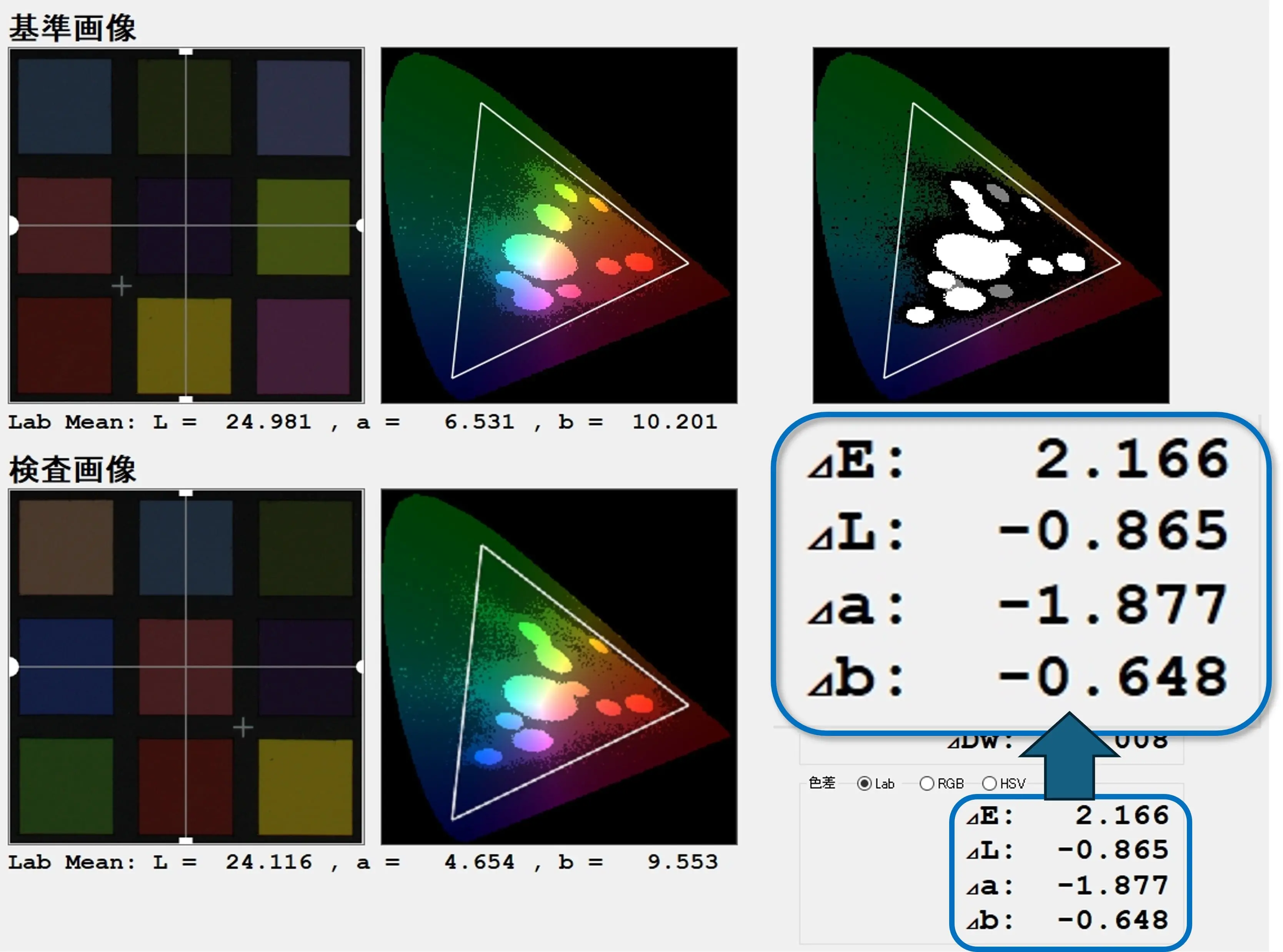
Color Difference Inspection (Example): ΔE Between the Reference and Sample
PaPaLaB Technology — Next-Generation Color Evaluation with 2D Color MeasurementContact
Please feel free to contact us with any inquiries regarding our products, pricing, or quotations.
We also accommodate requests such as “I would like to see how measurement works in practice.”
Trial measurements are available, allowing you to experience actual measurement results firsthand.