Color Inspection and Digital Transformation — Making Color Visible Through Data
PaPaLaB Color
Measurement

Digital transformation (DX) is advancing rapidly across manufacturing and quality control.
DX is not simply about converting analog information into digital form. More importantly, it is about using data to improve decision-making, solve problems, and support continuous improvement.
Color inspection and color quality control are no exception. Traditionally, color inspection has often relied heavily on visual evaluation, with judgments influenced by the experience and perception of individual inspectors.
An important step toward digital transformation in color management is to reduce subjectivity, make color quality visible through data, and establish more consistent evaluation methods.
This page explains the role of digital transformation in color inspection and introduces PaPaLaB’s approach to color management by combining images with numerical color data.
Contents
What Is Digital Transformation (DX)? — More Than Simply Going Digital
Digital transformation does not simply mean replacing paper documents with electronic files or introducing IT systems into existing workflows. These activities are only the starting point.
The broader value of DX lies in changes such as:
– Replacing subjective or experience-based judgments with data-driven decision-making
– Making information easier to share across departments and production processes
– Collecting and analyzing historical data to identify trends and support future improvements
In other words, DX involves turning knowledge and judgments that previously depended on individual experience into information that can be shared and used consistently throughout an organization.
This can help companies improve quality, productivity, consistency, and operational efficiency.
The same concept can be applied to color inspection and quality assurance.

Why Digital Transformation Matters in Color Inspection — From Visual Evaluation to Measurable, Traceable Data
Color can appear different depending on lighting, materials, background conditions, and individual differences in visual perception.
As a result, inspection results based primarily on visual evaluation can vary from person to person and can be difficult to document objectively.
This is why digital color management is becoming increasingly important.
Color quality can be managed by:
– Measuring it numerically using L*a*b* values and color difference metrics such as ΔE
– Recording images to visualize where and how color variations appear
– Accumulating inspection records for process control, traceability, and continuous improvement
This data-driven approach represents the digital transformation of color inspection.
It can provide benefits such as:
– Faster identification of potential causes of quality problems
– Trend analysis through comparison with historical data
– Clearer inspection criteria
– Reduced reliance on extensive visual inspection training
By turning color into measurable and traceable data, organizations can move away from inspection that depends primarily on individual experience.
PaPaLaB’s Approach to Digital Color Management — Integrating Images and Color Data
A key feature of PaPaLaB’s color measurement systems is that they provide more than numerical color measurements alone.
They can acquire and store both images and numerical color data, allowing users to understand not only how much a color differs from a reference, but also where that difference occurs across the measured area.
●Visualizing Color Variation Through Imaging
– Images of the entire measurement area can be captured, helping users identify color unevenness, abnormalities, and variations.
– Captured images can be stored as inspection records, allowing users to review the condition of a sample at the time of measurement.
●Pixel-Level Color Information
– Color data can be acquired and analyzed for individual pixels across the measured image.
– Quantitative evaluation can be performed using ΔE values, color distribution maps, and other analytical tools.
– Users can identify where color differences occur and evaluate both the magnitude of the color difference and how the color has shifted.
●Remote Analysis and Management
– Because color data can be stored and shared together with captured images, measurement results can be reviewed and analyzed remotely.
– Headquarters and production sites in different locations can review the same images and numerical data when evaluating color quality.
This makes it possible to connect the entire color management process: visualizing, measuring, recording, and sharing.
By reducing dependence on individual inspectors and enabling remote access to measurement data, teams can share color information and use it collectively for decision-making, communication, and improvement.
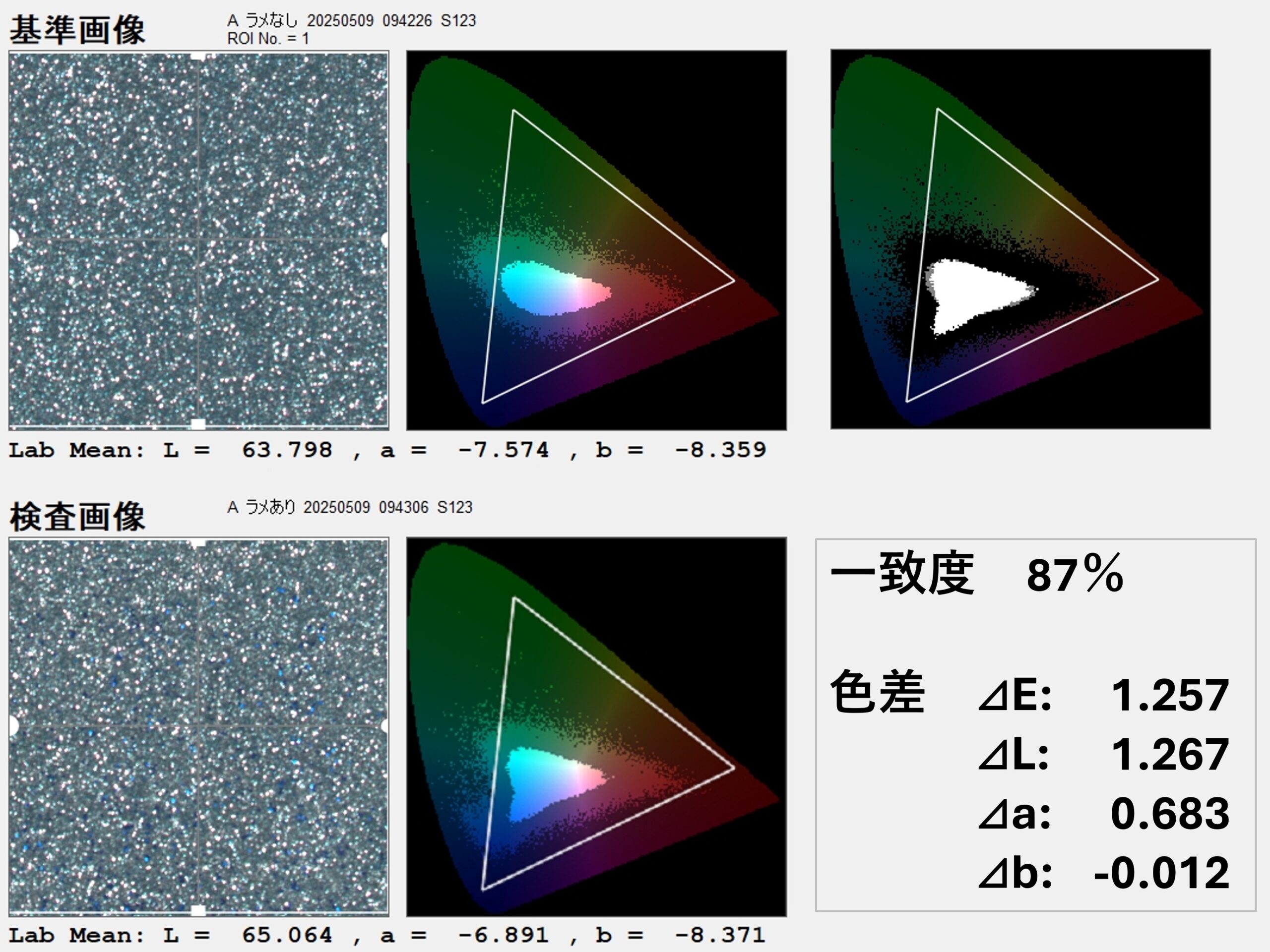
Measurement Screen (Partial View): Visual Confirmation of the Captured Image and Measurement Values
How Digital Transformation Changes Color Inspection — From Measurement to Sharing and Continuous Improvement
One of the greatest benefits of digital transformation in color management is that color-related information and decisions no longer remain confined to individual inspectors or production sites.
Color inspection based on images and numerical data can transform the inspection process in several ways.
●From Visual Impressions to Objective Data
Instead of saying:
“Something about the color looks slightly different,”
inspection results can be expressed more objectively, for example:
“The measured color difference is ΔE 1.2, and the L*a*b* values show how the sample differs from the reference.”
This allows different people to review the same data using common evaluation criteria.
Similarly, instead of relying only on written or verbal descriptions, captured images and numerical values can be stored so that others can review the condition of the sample at the time of inspection.
●From Inspector-Dependent Judgment to Consistent Data-Based Inspection
Inspections that previously depended heavily on individual experience or visual sensitivity can be made more consistent through quantitative comparison with reference colors.
This helps establish more consistent decision-making across different inspectors and production sites.
It can also reduce reliance on individual experience and decrease the time and effort required to train inspectors in visual evaluation.
●From Local Inspection to Remote Sharing and Analysis
Measurement data collected at a remote production site can be reviewed by headquarters or specialist teams using both images and numerical values.
If a quality issue occurs, the relevant images and measurement data can be shared quickly, helping teams understand the situation and make decisions more quickly.
●From One-Time Inspection to Continuous Improvement
Inspection results can be stored as historical records containing both images and numerical data.
This makes it possible to analyze trends, support improvement activities, and investigate the causes of recurring quality problems.
The same records can also be used to evaluate lot-to-lot stability and verify the effectiveness of corrective actions.
Through this approach, color inspection can become more than a simple checking process—it can also provide valuable information for quality assurance, process improvement, and organizational learning.
Summary — From Visual Judgment to Shared, Data-Driven Color Management
Color is an important factor closely related to product quality, brand value, and customer experience.
Rather than relying only on visual inspection to determine whether a product’s color is acceptable, modern color inspection increasingly involves measuring color numerically, capturing it as images, and managing both as data.
This is a key aspect of digital transformation in color inspection.
PaPaLaB combines images with pixel-level numerical color data to provide a more comprehensive record of color quality. This approach supports consistent quality control, better decision-making, communication, traceability, and continuous improvement throughout an organization.
By reducing dependence on inspector-specific evaluation and enabling teams to visualize, share, and use color data together, PaPaLaB offers a data-driven approach to color management.
This is PaPaLaB’s approach to digital transformation in color management.
Contact
Please feel free to contact us with any inquiries regarding our products, pricing, or quotations.
We also accommodate requests such as “I would like to see how measurement works in practice.”
Trial measurements are available, allowing you to experience actual measurement results firsthand.