Product Development with Consistent Color and Material Appearance
PaPaLaB Color
Measurement

A product’s appeal and perceived quality depend on more than specifications and functionality.
The impression users form when they see and touch a product is strongly influenced by the consistency of its color, materials, and finishes.
In recent years, CMF design—Color, Material, and Finish—has attracted growing attention as an approach to designing this kind of sensory and emotional value.
However, faithfully reproducing the original CMF design intent from development and prototyping through to mass production requires more than subjective judgment. Effective color management using numerical data and images is therefore increasingly important.
This page introduces the fundamentals of CMF, key points for managing color throughout the product development process, and the value of PaPaLaB’s integrated approach combining images and data.
Contents
What Is CMF? — Designing Impressions Through Color, Material, and Finish
CMF is an approach that integrates three elements—Color, Material, and Finish—to shape a product’s appearance, tactile feel, perceived quality, and overall visual identity.
The key is not simply to select a color, but to design and reproduce the impression created by the combination of color, material, and finish.
For example, even the same “white” can create very different impressions when applied to matte ceramic and glossy plastic.
However, changes in color appearance caused by differences in materials and finishes can be extremely subtle, making it very difficult to evaluate and maintain consistency based on human perception alone.
Why Turn Color into Data? — Using Objective Data to Support Color Adjustment
The way color appearance changes with different materials and finishes is caused by physical phenomena such as the reflection and scattering of light.
For example, even when the same target color is specified, metal and resin interact with light differently, which can result in differences in perceived color.
To manage these differences accurately, it is important to quantify the magnitude and direction of the color difference.
Using color measurement instruments makes it possible to evaluate the direction of color shifts using L*a*b* values and quantify the overall magnitude of color differences using metrics such as ΔE.
This data can then provide an objective basis for supporting color adjustment toward the intended result.
In other words, managing color as data plays an important role in maintaining consistent color appearance across different materials and finishes—and this is also one of the major benefits of introducing color measurement instruments.
Color Management from Development to Mass Production
To turn CMF design intent into a finished product, color needs to remain visible, measurable, and manageable at every stage, from design and prototyping through to mass production.
The key color management points for each phase are outlined below.
1. Design Phase: Quantify and Share the Design Intent
Establish quantitative color criteria, such as reference samples and Lab values, based on the intended design appearance.
Build a shared understanding using measurable reference colors rather than relying solely on verbal descriptions.
2. Material Sample Phase: Measure Changes in Appearance Caused by Materials and Finishes
Create samples using the actual materials and finishes and quantify color differences caused by material characteristics.
Use L*a*b* values and ΔE to evaluate differences quantitatively and support color adjustment.
3. Prototype Phase: Verify Overall Consistency with Images and Numerical Data
Visualize the relationship between components and the overall product impression by comparing images and color information.
Evaluate how closely the prototype matches the intended CMF design from both visual and data-based perspectives.
4. Mass Production Phase: Maintain Color Consistency and Stability
Monitor quality through regular measurement and recording to prevent variation between production lots.
Store historical color data to support traceability and continuous improvement.
PaPaLaB’s Solution — Integrating Images and Numerical Data
PaPaLaB’s two-dimensional color measurement systems are designed to acquire, analyze, and manage numerical measurement data and image information simultaneously.
This creates value at every stage from development through to mass production:
– Images and pixel-level data can be used to identify where color differences occur, in which direction the color has shifted, and by how much.
– Measurement data can be linked with images and stored as historical records, making it possible to visually track changes at each stage.
– Because measurement data and images can be shared digitally, remote analysis, evaluation, and communication are possible between geographically separated sites, including headquarters and overseas factories.
By establishing a system that not only evaluates color visually but also measures, records, and shares it as data, organizations can protect and maintain CMF design intent throughout the entire product development process.
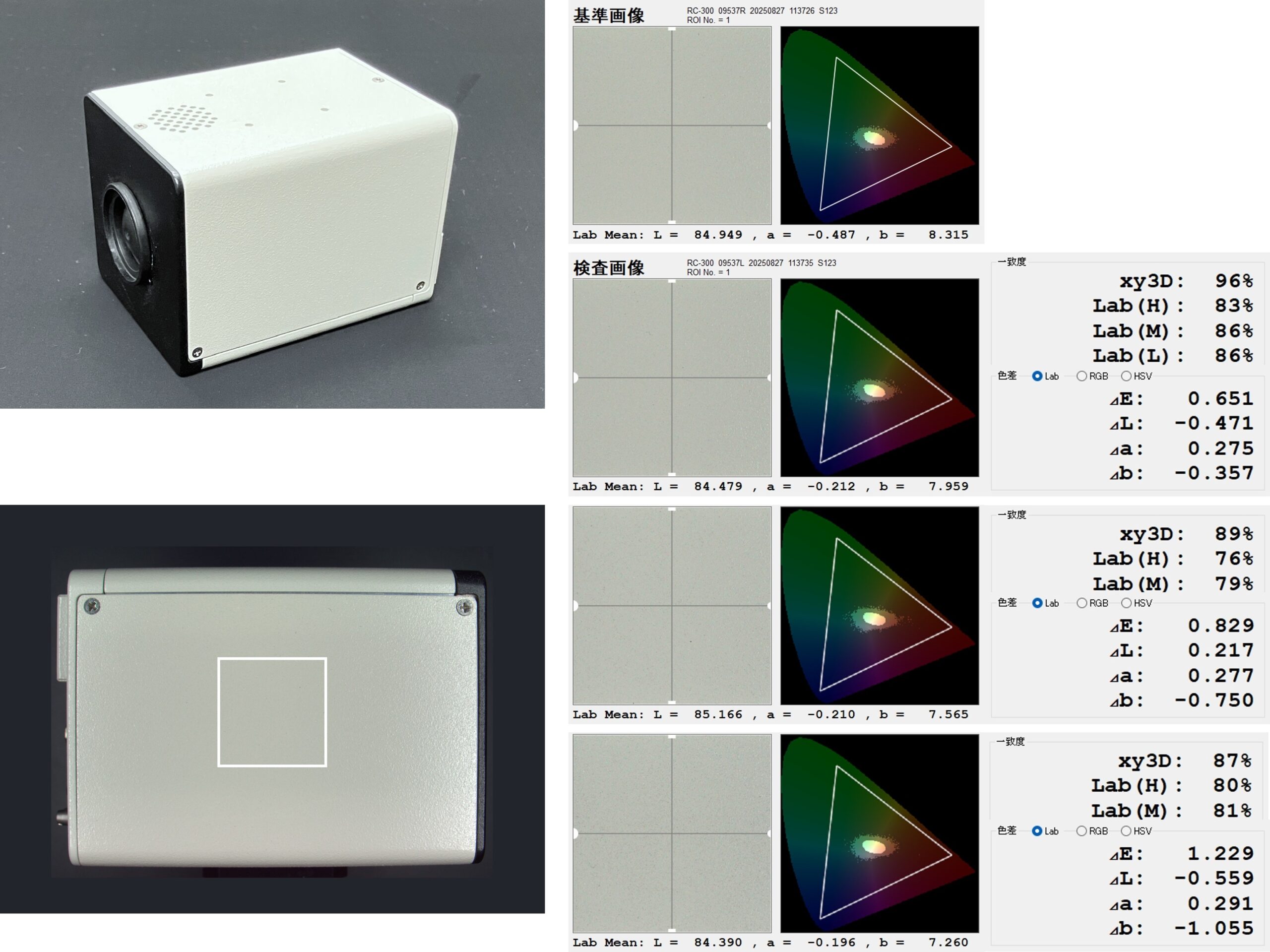
Top left: Product / Bottom left: Captured Image / Right: Inspection Image and Data
PaPaLaB Technology — Next-Generation Color Evaluation with 2D Color MeasurementSummary
Color and material appearance are among the most important factors in determining how a product is perceived.
However, their appearance can change significantly depending on the material and finish, making this an area where subtle adjustments are often required.
Rather than relying solely on human perception to manage these delicate differences, companies need a system that makes them visible through numerical data and images and enables them to be evaluated and managed objectively.
PaPaLaB provides color measurement systems that enable color to be captured, shared, and stored as both numerical data and images throughout the design, prototyping, and mass-production phases.
Maintaining CMF design intent from development through to the final product—that is the value of making color visible through digital data.
Contact
Please feel free to contact us with any inquiries regarding our products, pricing, or quotations.
We also accommodate requests such as “I would like to see how measurement works in practice.”
Trial measurements are available, allowing you to experience actual measurement results firsthand.